AI Literacy: Future-Proofing Education for 2026
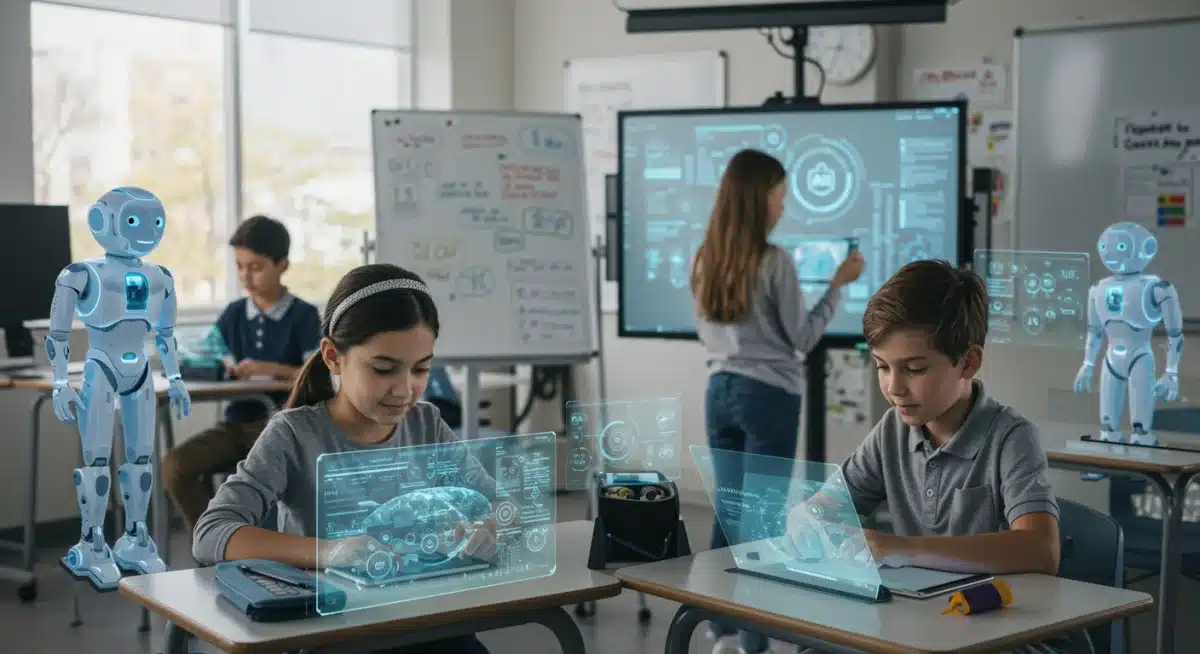
Integrating AI literacy into K-12 education is essential for preparing children for the future workforce and responsible digital citizenship by 2026, fostering critical thinking and innovation.
In an increasingly technologically driven world, the imperative to equip the next generation with relevant skills has never been more pressing. Future-Proofing Your Child’s Education: A 2026 Guide to Integrating AI Literacy from Elementary to High School is no longer an abstract concept but a critical educational goal, ensuring that students are not just consumers of technology, but informed creators and ethical participants in an AI-powered society.
The urgent need for AI literacy in K-12
The rapid evolution of artificial intelligence demands a fundamental shift in educational paradigms. By 2026, AI will be interwoven into nearly every aspect of daily life and the global economy. This necessitates that our children understand not only how to use AI but also its underlying principles, ethical implications, and societal impact.
Ignoring AI literacy would be akin to omitting computer literacy in the 1990s, leaving an entire generation unprepared for the workforce and civic engagement. Early exposure builds a strong foundation for future learning and adaptation in a world increasingly shaped by intelligent systems.
Understanding AI: Beyond the buzzwords
Many perceive AI as a complex, inaccessible field. However, AI literacy at the K-12 level focuses on demystifying these concepts, making them understandable and relatable. It’s about breaking down intimidating jargon into manageable, age-appropriate learning modules.
- Demystifying algorithms: Helping students understand how AI makes decisions.
- Data privacy and ethics: Teaching responsible data usage and the moral dilemmas surrounding AI.
- Applications in daily life: Exploring how AI impacts everything from recommendations to healthcare.
By fostering a foundational understanding, we empower students to critically assess AI technologies rather than passively accepting them. This critical thinking is paramount in navigating a future where AI systems are ubiquitous.
The urgency stems from the pace of change. What is cutting-edge today will be commonplace tomorrow. Therefore, the curriculum must be dynamic, adapting to new advancements while solidifying core principles. This proactive approach ensures that educational systems remain relevant and effective.
Integrating AI in elementary school: building foundational curiosity
Introducing AI concepts at the elementary level might seem ambitious, but it’s crucial for fostering early curiosity and breaking down misconceptions. Young minds are incredibly adaptable and absorb new information readily, making this an ideal stage for foundational learning.
The approach in elementary school is less about complex programming and more about playful, interactive exploration. Think of it as planting seeds of understanding that will grow into deeper knowledge as students progress through their education.
Play-based learning and simple concepts
Elementary AI education should be hands-on and engaging. Activities can include simple coding games that introduce logical thinking, or interactive robots that demonstrate basic AI principles like pattern recognition and decision-making. The goal is to make learning fun and accessible.
- Robotics basics: Using programmable robots to teach sequencing and problem-solving.
- Pattern recognition games: Activities that help children understand how AI identifies patterns.
- Storytelling with AI: Exploring AI’s role in generating creative content or assisting with narratives.
These early experiences demystify AI, transforming it from an abstract, intimidating concept into a tangible, exciting field of study. It helps children see AI as a tool they can understand and eventually control, rather than something that controls them.
Moreover, introducing ethical considerations at a young age, such as fairness and bias in simple terms, helps cultivate a generation of responsible digital citizens. This groundwork is invaluable for their future interactions with advanced AI systems.
AI literacy in middle school: bridging theory and application
Middle school serves as a critical bridge between the playful exploration of elementary school and the more structured, in-depth study of high school. At this stage, AI literacy moves beyond basic concepts to more practical applications and theoretical understanding.
Students in middle school are ready for more complex problem-solving and can begin to grasp the ethical dimensions of AI in greater detail. The curriculum should encourage experimentation and critical inquiry, preparing them for advanced studies.
Project-based learning and ethical discussions
Middle school AI education can involve project-based learning where students design simple AI models or explore data sets. This hands-on approach allows them to see AI in action and understand its potential and limitations. Discussions around AI ethics become more nuanced.
- Simple machine learning projects: Using visual programming tools to create basic AI models.
- Data analysis for social good: Exploring publicly available data to solve community problems.
- Debates on AI’s impact: Discussing the pros and cons of AI in areas like automation or privacy.
These activities help students develop a deeper appreciation for AI’s capabilities while also recognizing its challenges. They learn to question, analyze, and form informed opinions about technology that will shape their adult lives.
Furthermore, introducing students to various AI careers and the interdisciplinary nature of AI can inspire future academic and professional paths. This exposure broadens their horizons and connects their learning to real-world opportunities.
High school AI curriculum: preparing for advanced studies and careers
By high school, AI literacy should evolve into a robust curriculum that prepares students for college-level studies, vocational training, or direct entry into technology-driven careers. The focus shifts to more sophisticated technical skills, complex ethical frameworks, and real-world problem-solving.
High school students should engage with AI at a level that enables them to contribute meaningfully to its development and application. This means moving beyond basic understanding to practical implementation and critical analysis.
Coding, advanced concepts, and societal impact
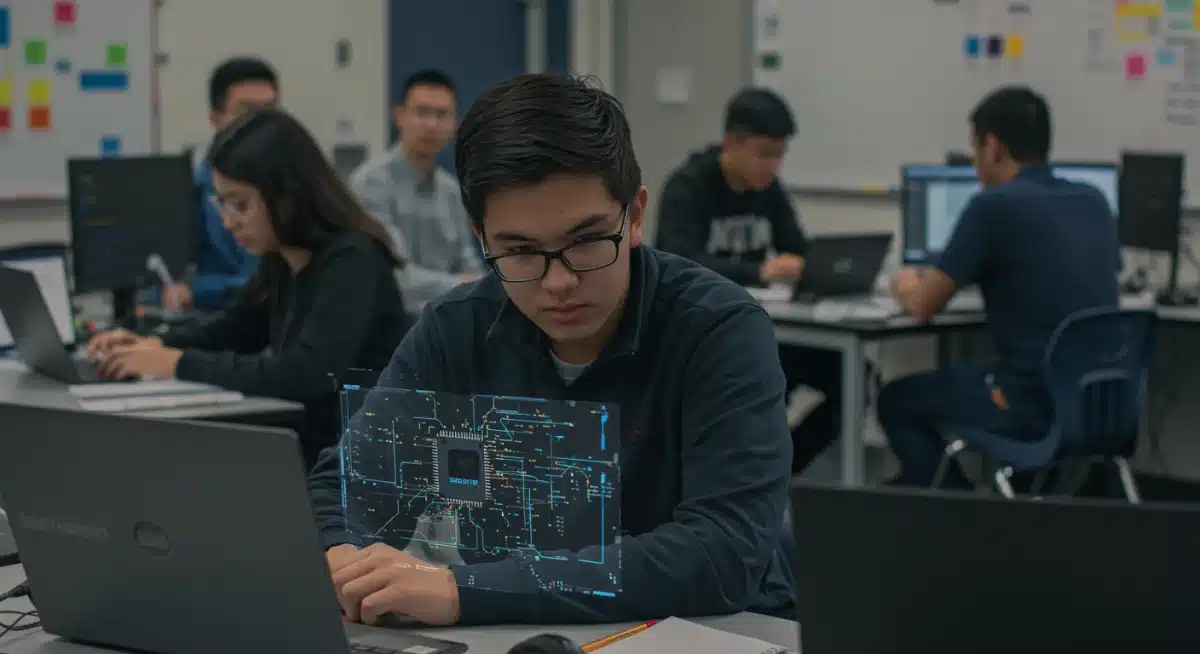
The high school AI curriculum should include programming in languages like Python, focusing on machine learning libraries and data science tools. Students should work on more complex projects, potentially collaborating with local industries or research institutions. Ethical considerations become central to every project.
- Applied machine learning: Building and training predictive models for various applications.
- Natural language processing and computer vision: Exploring how AI interacts with human language and images.
- AI ethics and policy: Analyzing the societal implications of AI and potential regulatory frameworks.
This advanced exposure equips students with the technical prowess and critical thinking necessary to navigate the complexities of AI. They learn to develop AI solutions responsibly, considering fairness, accountability, and transparency.
Moreover, high school is the ideal time to delve into specialized areas of AI, allowing students to discover their passions and pursue specific interests within the field. This personalized learning approach can significantly enhance their future prospects.
Teacher training and resource development for AI literacy
The success of integrating AI literacy into K-12 education hinges critically on adequately trained educators and robust, accessible resources. Teachers are the frontline implementers of any new curriculum, and their preparedness is paramount to effective delivery.
Without ongoing professional development and readily available teaching materials, even the most well-intentioned curriculum changes will fall short. Investing in teachers is investing in the future of AI literacy.
Empowering educators with AI expertise
Teacher training programs must be comprehensive, offering both theoretical knowledge and practical skills. Educators need to understand AI concepts themselves before they can effectively teach them. This includes workshops, online courses, and collaborative learning communities.
- Professional development workshops: Focusing on AI fundamentals, pedagogical strategies, and ethical considerations.
- Access to AI tools and platforms: Providing teachers with hands-on experience using educational AI software.
- Peer-to-peer learning networks: Creating communities where educators can share best practices and challenges.
Beyond initial training, continuous professional development is essential as AI technology evolves rapidly. Teachers need access to updated resources and ongoing support to remain current and confident in their instruction.
Furthermore, developing a repository of high-quality, age-appropriate AI curriculum materials, including lesson plans, activities, and assessment tools, is crucial. These resources should be open-source and easily adaptable to diverse classroom environments.
Addressing challenges and ensuring equitable access to AI education
Implementing a comprehensive AI literacy program across all K-12 schools presents significant challenges, particularly concerning equitable access. The digital divide and disparities in resources can exacerbate existing educational inequalities, making it crucial to address these issues head-on.
Ensuring that every child, regardless of socioeconomic background or geographic location, has access to quality AI education is a moral and societal imperative. This requires strategic planning and dedicated investment.
Overcoming the digital divide and resource disparities
Access to technology, internet connectivity, and trained educators varies significantly across school districts. Bridging this gap requires targeted initiatives, funding, and partnerships to ensure all students have the necessary tools and support for AI learning.
- Government funding and grants: Allocating resources specifically for AI education infrastructure and teacher training in underserved areas.
- Community partnerships: Collaborating with tech companies, universities, and non-profits to provide resources and mentorship.
- Flexible learning models: Utilizing online platforms and blended learning to reach students in remote or resource-limited settings.
Beyond technology, curriculum development must also consider cultural relevance and diverse learning styles. AI education should be inclusive, reflecting the experiences and perspectives of all students, thereby fostering broader engagement and interest.
Ultimately, a concerted effort from policymakers, educators, parents, and technology leaders is required to overcome these challenges and build a truly equitable AI education system that benefits all children.
| Key Aspect | Brief Description |
|---|---|
| Early AI Exposure | Introducing basic AI concepts through play-based learning in elementary school to build foundational curiosity. |
| Middle School Application | Bridging theory and practice with project-based learning and ethical discussions on AI’s impact. |
| High School Readiness | Preparing students with coding skills, advanced AI concepts, and critical analysis for future careers and studies. |
| Teacher Empowerment | Ensuring educators receive comprehensive training and access to resources for effective AI literacy instruction. |
Frequently asked questions about AI literacy in education
Introducing AI literacy early helps children develop foundational critical thinking skills, demystifies technology, and sparks curiosity. It prepares them for a future where AI is prevalent, fostering a comfort and understanding that prevents intimidation later on.
Schools can start with free online resources, open-source AI tools, and partnerships with local tech companies or universities. Focusing on conceptual understanding and ethical discussions rather than solely on advanced coding can also reduce initial resource demands.
Key ethical considerations include data privacy, algorithmic bias, the impact of AI on jobs, accountability in AI decision-making, and the responsible use of AI for societal benefit. These topics should be introduced age-appropriately and discussed critically.
No, AI is a tool to augment, not replace, human teachers. AI can personalize learning, automate administrative tasks, and provide data insights, allowing teachers to focus more on mentorship, critical thinking development, and emotional support, which AI cannot replicate.
Virtually all careers will benefit from AI literacy. Beyond traditional tech roles like AI engineers and data scientists, fields such as healthcare, law, marketing, arts, and even skilled trades will increasingly rely on AI tools and understanding AI’s capabilities.
Conclusion
The journey to Future-Proofing Your Child’s Education: A 2026 Guide to Integrating AI Literacy from Elementary to High School is a multifaceted but essential undertaking. As AI continues to reshape our world at an unprecedented pace, providing children with a deep, ethical, and practical understanding of this technology is no longer optional. It is the cornerstone of their future success and societal contribution. By thoughtfully integrating AI literacy across all educational stages, investing in teacher training, and ensuring equitable access, we can empower the next generation to not only adapt to an AI-driven future but to actively shape it responsibly and innovatively. The time for proactive educational reform is now, securing a brighter, more informed future for all.